
 Rasika Karkare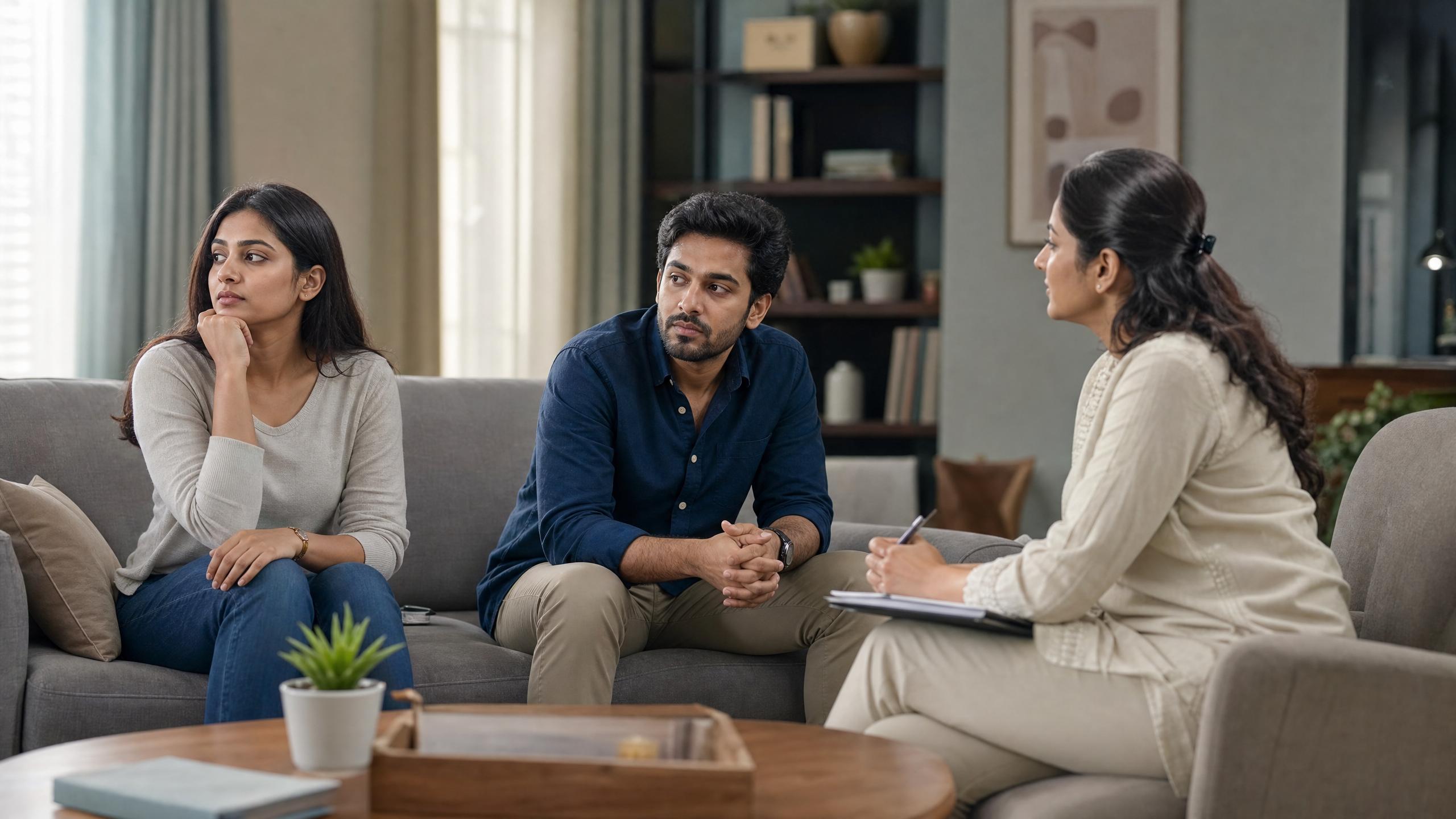
Couples therapy can be a valuable source of support for any couple who is facing issues and difficulties in their relationship. It can help address issues with trust, communication, intimacy, parenting, and more. However, discussing the topic of couples therapy with your partner can be an overwhelming task, and once you do begin therapy, you may have questions or concerns about how the process works, especially around whether the therapist will take sides or even decide the fate of your relationship.
In this article, we will explore how to approach the difficult conversation of suggesting couples therapy to your partner, what to do if they refuse, and address common concerns such as whether marriage counsellors take sides or might ask you to leave your partner.
How To Tell My Husband We Need Marriage Counselling?
Initiating a conversation about marriage counselling with your husband or spouse can feel overwhelming. Here are some steps that can help you have a productive discussion on the topic.
Organize Your Thoughts
Since the topic of marriage counselling is usually overwhelming, it might be a good idea to write or make a list of points that you want to discuss with your husband during the conversation. This exercise will help you gain clarity about how and what you want to convey to your husband.
Make sure you include points around what you would like to achieve from marriage counselling and why it might be the right time for you to consider it as a couple. The more clarity you have, the easier it will be to talk to your husband.
Pick A Good Time And Place
It can be difficult to have a conversation around marriage counselling when either you or your husband are already stressed. So, make sure you select a time when both of you are relaxed and free from distractions. Also, create or choose a comfortable space where you can talk openly without interruptions.
Share Your Feelings And Concerns
Start the conversation by expressing your feelings honestly and respectfully. Make sure you share your feelings in a non-confrontational and productive way so that your husband doesn't feel blamed. A good way to convey your feelings in a non-blaming way is by using 'I' statements. For example, say, "I've been feeling concerned about our relationship lately, and I think we could benefit from marriage counselling''.
Frame It As A 'We Thing'
Once you have expressed your concerns regarding the relationship, reassure your husband that you are not blaming him for the issues in the relationship; rather, you want to work as a team to make the relationship better. For example – "I believe we can address the recent communication issues with the help of marriage counselling''.
Focus On The Benefits
Highlight how marriage counselling can potentially benefit your relationship, emphasizing that counselling is a proactive step toward strengthening your bond and resolving issues constructively. Reiterate that seeking marriage counselling means both of us are committed to each other and want to create a long-lasting marriage.
Consider Your Husband's Perspective
Once you have shared your thoughts, acknowledge that the prospect of marriage counselling can be overwhelming. Then, let your husband express any thoughts and opinions that he has about the idea. Listen actively without interrupting or dismissing his feelings. Validate his emotions, even if he is resistant to the idea of counselling.
Provide Reassurance
Assure your husband that you are willing to work through challenges together and help him address any concerns or doubts that he has regarding marriage counselling. Providing reassurance indicates that you and your husband are on the same team.
Have Patience
Understand that seeking marriage counselling is not an easy decision, so allow your husband time to process his emotions and make a decision. Allow him to ask any questions as well.
Reaching Out
If your husband agrees to marriage counselling, make it a collaborative effort by researching therapists together and choosing a therapist that you both feel comfortable with.
What If I Want To Go For Couples Therapy But My Partner Doesn't?
Sometimes, one partner is ready to seek help while the other isn't. The good news is that your partner's refusal to seek couples therapy does not have to bring your relationship to a dead end. Here are some ways to navigate the situation effectively.
Understand Your Partner's Perspective
The idea of couples therapy might be extremely daunting for some people, especially in a country like India where mental health is still a taboo topic and relationship issues are seen as a private matter not to be discussed outside the family. Take time to understand why your partner's resistance. Allow them to express their feelings without interruption and approach the conversation with genuine interest.
Don't Judge Or Blame Them
While it is natural to feel frustrated when your partner resists couples therapy, avoid any judgements and blame. Judgements and blame can often escalate tensions and lead to conflicts instead of productive communication. Focus on creating a safe environment and have open conversations about how you can improve the relationship.
Openly Share Your Feelings
Talk to your partner openly about why couples therapy is important for you and how it will help the relationship. Use gentle I statements such as 'I feel we can work together to strengthen our connection in couples therapy'. Using I statements keeps the focus on your feelings rather than making your partner defensive.
Start With A Trial
If your partner is hesitant, suggest the option of trying couples therapy for a few sessions or on a short-term basis, like two to three sessions, to evaluate if it's helpful. This can reduce the pressure on your partner to commit to the therapy process.
What If My Partner Still Doesn't Agree?
Remember, it is completely okay if your partner continues to resist even after an open conversation. There are still other options you can explore, such as:
Try Individual Therapy
While couples therapy is effective for relationship issues, individual therapy can be helpful as well. It provides you with a safe space to express your concerns while also helping you address any unhelpful thoughts or behaviours that might be impacting your relationship, thus leading to positive changes.
Start With Small Steps
While the idea of couples therapy can be overwhelming, you can always start with other small steps to improve your relationship, such as reading self-help books for couples, attending couples workshops or watching videos that offer practical tips and strategies. These little steps can take your relationship towards positive changes.
Reflect On What Has Already Worked
All relationships go through highs and lows. In times of conflict, it might be helpful to think about what has previously worked and brought you close as a couple. Was it spending quality time together or showing affection? Going back to these habits can rekindle your connection.
Appreciation And Gratitude
Expressing appreciation for your partner's efforts and acknowledging even small contributions can go a long way in changing the dynamic and atmosphere of your relationship. Appreciation and gratitude create mutual respect, which can help reduce conflict.
Seek Support From Others
Reach out to trusted friends and family members to share your feelings. Sometimes, hearing from someone who has been through similar challenges can provide validation and a different perspective.
Why Do Marriage Counsellors Always Side With The Wife?
Have you ever walked out of a marriage counseling session feeling like the counsellor was siding with your wife? If yes, you are not alone. Many men feel that the counselor might favour their wives in the session. This fear can often stop or discourage men from participating in marriage counseling. However, do marriage counsellors take sides, or does it just seem that way? Let's explore the answer to this complex question in depth.
Understanding The Role Of A Marriage Counselor
In simple terms, a marriage counselor, also known as a couples therapist, is a person trained to help couples identify issues in their relationships and provide tools to improve various areas of their relationship, such as intimacy, communication, and conflict management. A marriage counsellor essentially acts as a safe space for couples to resolve their issues in a neutral and unbiased environment.
Effective marriage counselors often treat the relationship and the dynamics between the couple as a client instead of focusing on one particular individual; thus, they are unlikely to take sides or prioritize one spouse over another.
Additionally, a good marriage counselor understands that progress can only be made when both spouses feel heard and comfortable in the counselling space. So**, they focus on understanding the perspectives of both sides instead of deciding between who is right and who is wrong.**
Why May It Seem Like A Marriage Counselor Is Taking Sides?
While marriage counselling is a neutral space, there are a few reasons why it may feel like the counselor is siding with one partner over the other. Let's explore these reasons in depth.
Wives May Be More Open To Sharing And Expression
One reason it might seem like counselors focus more on the wife is that women may generally feel more comfortable talking about their feelings as compared to men. Thus, if the wife is more expressive and the husband is more reserved; it may seem like the counselor is focusing more on the wife.
Some Questions May Be Difficult Or Uncomfortable
Counselors ask difficult questions to help uncover underlying issues in a marriage. These questions might feel intrusive, especially if they require husbands to talk about their deepest feelings or emotional needs.
On the other hand, wives may be more open to answering these questions, making it seem like the counselor is siding with them rather than challenging both partners equally.
Sometimes The Counselor May Provide Feedback
Once a counselor gets an overview of the couple's relationship dynamics, they may provide feedback on changes or areas for improvement. The feedback is generally delivered in a non-confrontational way and is directed towards both partners.
However, sometimes one or both partners may interpret this feedback as criticism, leading them to believe that the counselor is supporting one partner over the other.
Is It Possible For A Marriage Counselor To Take Sides?
While marriage counselors strive to be neutral, they are human too. Sometimes, unconscious biases or personal experiences may subtly influence how they interact with a couple. For example, a counselor may unconsciously relate to one partner's way of communicating and give them more time to speak. However, most trained counselors recognize and correct any potential bias to ensure both partners feel heard.
Thus, if you feel like your therapist is taking sides, it's important to address it rather than assuming they are intentionally favoring your spouse. In the next section, we will look at a few steps you can take in such situations.
What To Do If You Are Feeling Unheard?
- If you feel your perspective isn't heard, openly discuss it with your counselor. A good counselor would receive the feedback and work towards corrective measures.
- Ask the counselor more questions to clarify if something they did or said comes across as biased or taking sides. Seeking clarifications can prevent misunderstandings.
- Talk to your spouse outside of therapy about how you feel, as they may not realize that you are feeling unheard. Open conversation can ensure that therapy remains safe space for both of you.
- If you've tried addressing the issue and still feel that your counselor is biased, it may be worth considering a different therapist. Finding someone who makes you feel comfortable and understood is crucial for effective therapy.
- Lastly, if marriage counselling seems overwhelming**, consider individual therapy**. Individual therapy sessions can make it easier for you to express yourself.
Will Your Therapist Ask You To Leave Your Partner As A Result Of Couples Therapy?
The thought of seeking couples therapy can be very stressful, especially when couples are attending a session for the first time. Many couples might be nervous thinking that the therapist will decide the fate of their relationship for them and ask them to break up as a result of couples therapy sessions. While such concerns are absolutely valid, it is unlikely for a therapist to do so. In fact, it is considered unethical for a therapist to make any decisions for their clients, whether that be making the relationship work or parting ways.
What Does An Ethical Couples Therapist Look Like?
Couples therapy requires an environment of trust and safety, thus finding the right therapist is critical for the therapy process to be effective. Here are some green flags you might want to look for and some red flags you might want to avoid in a couples therapist.
Green Flags
- The therapist creates a safe and non-judgemental environment for both partners
- Empowers the couple to decide for their relationship
- Helps both partners to have a healthy dialogue with each other
- The therapist has a plan based on the couple's goals
- The therapist is open to feedback and adapts according to the couple's needs
Red Flags
- The therapist finds it difficult to be objective and lets their own opinion influence the therapy process
- Advises on what the couple should do regarding their relationship
- Takes sides and supports one partner over the other
- The therapist might take a directive stance & make goals for couples
- The therapist acts defensive when they get feedback
What Does Couples Therapy Look Like?
Couples therapy focuses on helping couples work through the challenges that they are facing in their relationship. Couples therapy provides both partners with a safe and neutral space to understand their relationship better and develop healthier ways to relate with one another. The therapist will help partners to open up by creating a trusting and confidential environment.
The initial appointment in couples therapy is usually focused on understanding the relationship history and the challenges that the couple is currently facing from both partner's perspectives. The therapist will ask questions to gather information about the same. The expectations and goals that the couple hopes to achieve from the therapy process are also discussed.
In further sessions, the therapist will help the couple explore their relationship dynamics to identify core issues and also look for unhelpful patterns of interaction that might be impacting the relationship. When key areas of work have been identified, the therapist will help both partners to learn skills to communicate and understand each other in better ways. The therapist might assign homework activities for both partners so that the concepts discussed in therapy can be used in real-life situations.
Is Couples Therapy Effective?
Having explored the process of couples therapy, you might be wondering if it really helps in improving couples' relationships. Let's look at what research has to say.
A research conducted in 2012 suggests that couple therapy positively impacts 70% of couples receiving treatment. Another research conducted in 2020 had similar findings, where it was found that 60–80% of distressed couples benefit from couples therapy.
Benefits Of Couples Therapy
It can be hard for a couple to work through certain relationship issues on their own. Couples therapy can be an option in such situations where the couple feels stuck. The potential benefits of couples therapy are:
- It provides couples with clarity on unhelpful dynamics existing in the relationship
- The therapist brings a neutral, honest perspective about the relationship, which might encourage partners to look at their relationship in new ways
- It gives the couple to look at and acknowledge positive aspects, and strengths in the relationship.
- Couples regularly create an environment to address things that might otherwise be left unspoken between them. The time they spend in therapy also allows them to make their relationship a priority.
While couples therapy can be an effective way for couples to work on their relationship, it is important to acknowledge that working through relationship issues requires patience and long-term commitment. Unfortunately, an average couple waits for 6 years before they seek professional help.
Conclusion
Initiating the conversation about marriage counselling can be extremely difficult. However, you can make it easier by approaching the conversation with clarity, sensitivity and an open mind. By choosing the right time and approach, expressing your concerns honestly, highlighting the benefits, offering support, considering your partner's perspective, and being patient, you can navigate this discussion effectively and take positive steps toward strengthening your marriage.
It is completely normal for some people, including your partner, to feel apprehensive towards couples therapy, as it can feel daunting, but it doesn't have to be the end of your relationship. Open conversation, empathy and other approaches such as individual therapy, self-help books, couple workshops and cultivating gratitude can help you work through relationship issues.
The idea that marriage counselors always side with the wife is a misconception, as counselors are trained to be neutral and their goal is to treat the relationship, not to decide who is right or wrong. Similarly, it is highly unlikely for an ethical therapist to decide the fate of the relationship for their clients. Thus, the responsibility of making a decision remains with the couple themselves. An ethical therapist acts as a support, providing the couple with a holistic view of their situation and also helps them develop effective strategies to reach their goals. Successful couple therapy provides both partners with the 'clarity' that they deserve.
If you are looking for marriage counselling, click here to book a session with a trained couples therapist at Mind Voyage right away.
References
- Bradbury, T. N., & Bodenmann, G. (2020). Interventions for Couples. Annual Review of Clinical Psychology, 16, 99–123. https://doi.org/10.1146/annurev-clinpsy-071519-020546
- Counseling, L. T. (2018, December 13). How To Make Progress When Your Spouse Refuses Marriage Therapy. Lime Tree Counseling. https://limetreecounseling.com/spouse-refuses-marriage-therapy/
- Couples Counselling: How to Ask Your Partner to go to Therapy | One Life Counselling & Coaching. (2020, February 2). https://onelifecounsellingcoaching.com/blog/how-ask-your-partner-go-therapy/
- Do Couples Therapists Take Sides? | Couples Therapy in Texas. (2022, August 30). Center for Couples Counseling. https://www.erikalabuzanlopeztherapy.com/blog-psychotherapy-marriage-counseling-infertility-postpartum-depression-minimalism-leaguecity-houston-tx/2022/8/30/do-couples-therapists-take-sides
- Everything You've Ever Wanted To Know About Going To Couples Therapy. (2019, October 13). Mindbodygreen. https://www.mindbodygreen.com/articles/when-to-go-to-couples-therapy-and-how-long-it-takes-to-work
- How to talk to your partner about Couples Therapy. (n.d.). Cerebral. Retrieved April 25, 2024, from https://cerebral.com
- Lebow, J. L., Chambers, A. L., Christensen, A., & Johnson, S. M. (2012). Research on the Treatment of Couple Distress. Journal of Marital and Family Therapy, 38(1), 145–168. https://doi.org/10.1111/j.1752-0606.2011.00249.x
- LPC, M. R. P. (2021, November 22). 11 Valuable Benefits of Couples Therapy. Talkspace. https://www.talkspace.com/blog/benefits-of-couples-therapy/
- McNeil, D. (2021, October 4). What to Expect When You Go to Couples Therapy. The Gottman Institute. https://www.gottman.com/blog/what-to-expect-when-you-go-to-couples-therapy/
- Shields, C. G., Finley, M. A., Chawla, N., & Meadors, W. P. (2012). Couple and family interventions in health problems. Journal of Marital and Family Therapy, 38(1), 265–280. https://doi.org/10.1111/j.1752-0606.2011.00269.x
- 5 Tips if Your Partner Won't go to Couples Therapy. (2015, August 31). Psych Central. https://psychcentral.com/relationships/what-to-do-when-your-partner-doesnt-want-to-attend-couples-counseling
- What to Do When Your Partner Won't Go to Couples Therapy | Psychology Today. (n.d.). Retrieved January 9, 2025, from https://www.psychologytoday.com/intl/blog/mindful-relationships/202305/what-to-do-when-your-partner-wont-go-to-couples-therapy
- Will my couples therapist take sides? (n.d.). Marriage Couples and Individual Counseling l Louisville, KY l Miranda Filamini. Retrieved February 26, 2025, from https://www.newpromisetherapy.com/blog/will-my-couples-therapist-take-sides
- Wittenborn, A. K., Woods, S. B., Priest, J. B., Morgan, P. C., Tseng, C.-F., Huerta, P., & Edwards, C. (2022). Couple and family interventions for depressive and bipolar disorders: Evidence base update (2010-2019). Journal of Marital and Family Therapy, 48(1), 129–153. https://doi.org/10.1111/jmft.12569